C
COLOURED PENCIL TOPICS

www.penciltopics.co.uk

THIS PAGE IS PART OF THE SECTION DEALING WITH

This link will take you direct to the main contents page for the site

THIS SECTION ALSO CONTAINS PAGES COVERING :

Pastel Pencil Techniques

Page Four


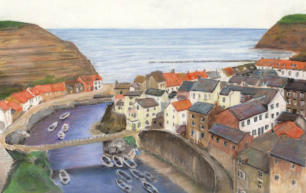
Staithes Town

North Yorkshire


Pastel Pencil

( Derwent New Formula )


on

Clairefontaine

Pastelmat


Picture

8 ins x 5.5 ins


© 2010 Peter Weatherill

THE HOW DO DO IT Page


Some notes to guide the beginner in the techniques for using Pastel Pencils

First of all let us look at the basic weapons used in this medium


Three images ..............


First of all

What a sharp pastel pencil does NOT look like


Second


What a Sharp Pastel Pencil DOES look like


and Third


What I use to get from picture 1 to picture 2

It seems obvious, I know,  but if you had walked round classrooms as many times as I have and pointed out to students as many times as I have, that they will never get a quality result with a poor quality point on the pencil, you would understand the reason for me making this note at the outset.

Using a blunt pencil is like trying to paint a watercolour with a yard broom

You need to have complete control over the mark you make, and you can only do that if you know exactly where the mark is going and how big the mark will be.  

Yes, I know that when you are laying down areas of background and putting down a base coat it is not so vital to keep the point pin sharp, but keeping a good point is a very good habit to get.


Remember though that you also need a waste container to put the rubbish in, and best of all, one that does not easily knock over.  I have a small piece of blu tac on the base of the table top pot I take around with me so that an accidental knock doesn’t result a load of mess


Hopefully the CP addicts who read this will already appreciate the points made.

I have been asked to go through the process, step by step, of sharpening a Pastel Pencil with a knife.  This is something I was taught to do many years ago by a superb teacher of Pastel Pencils, Colin Bradley, as the first step in working with this medium.  

It may seem to be very basic to some of you, but you would be amazed how many people I see working with pencils that have virtually no point to them.


It is a sad fact that Pastel Pencils wear down more quickly than almost any other pencil medium, so you have to be on the alert all the time to keep the point in ‘tune’.  If you don’t, the marks you make will become wider and less accurate.  Colin always sharpened his Pastel Pencils with a single edged razor blade, but these days very sharp craft knives are available which are much safer to use.


I start with a broken pencil.

For this I have selected one from the Derwent box - the Indigo , but the technique is the same whatever the colour or brand !!!    Some pencils are softer and require more care in cutting, some of the harder ones will take more pressure on the colour core.  It is a case of ‘know your pencils’.  

I chose the Derwent to demonstrate this process as these Pastel Pencils are slightly softer than many other brands so they need a little more care with the sharpening.  Some of the harder varieties will take careful sharpening in a  hand driven spiral cutting desk sharpener.

HOLD ON A MINUTE !       What happens if I go wrong ?


Good question, and one best looked at before we begin, so that we have the re-assurance and knowledge that disasters can be (mostly) put right if caught in time.


As pastel builds up on the working surface it becomes more and more difficult to correct, so any corrections need to be done whilst there is still some grain of the paper or card surface to go back to.  Dense pastel which has built up moves easily from side to side, but is very difficult to lift ( see bristle brush - below ).


The tools of the correction trade are as follows :  Blue tac/White tack.  Blue tac on its own tends to be on the stiff side and white tack tends to be softer and stickier.  A blend of the two makes an ideal lifting medium for pastel and a blob of the mixture kept to hand is invaluable.  Store it in between the fold of a small sheet of thick plastic or in a pot which you can get your fingers into to excavate it.  The mixture has a habit of ‘flowing’ if left for some time, so keep an eye on it.  I keep a bit stuck to the top of my easel and it is fairly well behaved there and doesn’t wander far.  This sticky mixture can be moulded into an exact shape to lift specific areas of pastel, and will lift pastel pigment from most surfaces and absorb the dust.  It also keeps your hands clean when you have been indulging in mixing the colours with your fingers. Just keep folding it in on itself to reveal a new sticky surface.  

The pale blue mixture will get greyer and greyer over the years but will still work well.  

I have a blob that is around 8 years old.


I prefer the tack mixture to the commercial kneaded erasers though it has to be said that the Faber-Castell kneaded eraser is equally as good. It works out somewhat dearer to buy but may be easier to find than the elusive UHU White tack.


A craft knife can be used to scrape away pigment, though care is needed that you don’t damage the working surface and ruin the grain of the paper for working the correction.


I have seen books quote using a ball of kneaded fresh bread as a good correction material that will lift colour from the surface, but I haven’t tried it.


I do keep a short bristle brush handy as this can remove some of the upper layers of pigment when the pastel gets too built up


CAN WE START NOW ?


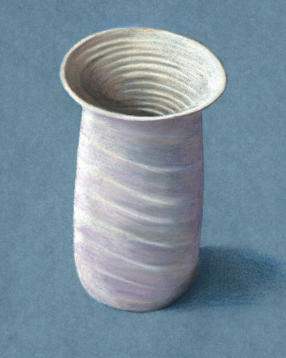
Let us look at a little vase as a subject.  

The pot has a matt surface and delicate colouring so is very suitable

to show the benefits of Pastel for both still life and portraiture


As Pastel is an opaque medium,

I will also be working on a coloured background,

merely to show how well it works and to point up the difference

between Pastel Pencils and the more transparent wax and oil  

based coloured pencils.


My paper is a 160gsm Ingres pastel paper and I am using it on the

smoother side rather than the ribbed one.  

I have the paper taped down to a drawing board so that the paper

stays absolutely flat, and there is a sheet of smooth card

underneath the working paper so that any imperfections in the board surface

are not carried through to the picture.

I also have a sheet of thin paper on the top and secured along one edge,

so that when I stop work, the covering paper can be brought over the artwork to

protect it from damage.  It all sounds a bit of a fiddle, I know, but you will

see the benefits as you work.


Here we have the layers - desk at the bottom,

then the drawing board

Then smooth white card, then the blue working paper,

finally the thin paper on top to provide protection


The board is A3 size

( for those in the rest of the world that is

16.5 inches by 11.75 inches approx ),

so the image I will work will be quite big for a little pot.   

That will scan well, though, for showing you the working process


And the final board looks like this.  

It is not necessary to tape all round the

working paper - we are not stretching it.  

The top is taped straight across and the sides just have enough

to stop the paper moving about.

The white card is just visible underneath,

and the protective layer is folded back.

You can use a little bit of tape on the bottom edge to

close down the top protection if you need to take the work

somewhere to work on it.

The protective layer can be ordinary white paper,

Glassine anti static paper or even brown paper

- it is just that I had tracing paper the right size, to hand.

WITH SHARP PENCILS AND PAPER TO HAND

WHERE DO WE START ?

I have drawn out the image using a limited number of colours.

At this stage I am just putting down the basis of the colour, so I have reserved white for the areas that are light, and the darker colours for the shadowed areas that I want to keep more subdued.  The colours chosen are White, Raw Umber (for the mid brown), and sepia ( for the darks - a very useful colour ) - these three provide the basis for the inside of the vase.  The Sepia used for drawing provides the dark limit of the side.   The colours for the outside of the vase are White for the lighter side and a combination of Purple and Magenta for the dark side.  The darkest part of the shadow has been marked in using sepia for now.

Notice that all the strokes follow the shape of the vase surface as we see it.  When shading in a curve, always turn the work surface (and the reference) so that your drawing hand moves with a normal wrist action and draws a natural curve.  It is much easier to move the paper around than to try to draw a curve in an unnatural way.

When we work in wax and oil based coloured pencils, we lay down a base coat of colour in the same way and build upon it. The initial base of the colour - the first layer - is vitally important in setting the tone and basic colour of the final layers as the wax based pencil goes down in semi transparent layers and each layer builds upon the previous layers.  


With pastel we still need those first layers to set the tonal and colour balance, but rather than just building layers like lines of bricks in a wall. Pastel also involves the mixing of the pigment on the paper, and we need that early foundation to provide the palette that the detail is worked into.  


A really dark area needs a really dark base.  A really light area needs a base of white.  Mid tones are less of a problem as added white will always lighten, and added darker colours will always darken.

Although this example is quite a large picture ( the image of the subject is 8 inches high), it took just over half an hour to get to this point.

Pastel is very quick to do.


Using the larger pastel sticks or blocks would have been even quicker, but the detail would have been more difficult to achieve

I have worked some heavier layers in with a Flesh coloured pastel to bring up the lighter areas.  That top edge of the vase looks a little wobbly at the moment but it should come right as the detail is built up.  

Notice that I have put some heavy vertical layers of light pastel down the left hand outside and also built up the right hand inside quite a lot.


Heavy use of a pastel pencil soon wears down the point. So you need to be aware of two essentials -

1. Keep the point at a reasonable length and sharpen up the pencil regularly to avoid working with a stump of pigment.  

2. Keep turning the pencil to get a fresh edge to the point, that flat point is very useful to get a crisp edge on a line.

You will build your own point as you work, so it is not necessary to sharpen up the actual point with a knife

until you get to the later stages of the work.

3. A piece of sandpaper is useful to tailor a point to an exact shape

Now we come to the big difference between Coloured Pencil and Pastel.

No additional pastel has been added to the image on the left.

The difference you see is that I have applied a clean forefinger to the pastel surface and rubbed it in - pressing the powdery material into the paper as I go.  There are those who recommend using a paper ‘torchon’ or a silicone tool to do the rubbing in, and these are very helpful in small detailed areas and small pictures where the finger does not easily fit.  One benefit of using the finger is that the dry skin holds a certain amount of powder which it picks up and blends.


CARE should be taken not to try this method with greasy or oily skin as the rubbing in process will not work as well and the pastel will absorb the grease and may permanently mark the picture.


The next step is to introduce some

more colour to the right hand

outside and work back into the

lighter left hand side.

I will also sort out that wobble

in the top edge

Here you can see that I have

added French Grey to the

right hand side -

all the way down

to the bottom

Look closely at the base where I have now gone back in with the Flesh pastel and

Shaded OVER the French Grey.  The Flesh pastel picks up and merges the colours.

I can repeat this process over and over working from opposite sides until the shading is

Evenly graded from left to right.


I can then repeat the process inside the vase and develop those ribs in the pottery

and finally put in the sharp and soft edges for shadows and sharpen up the top rim

This is not intended as a full ‘step by step’ exercise

- just an indication on various techniques.  

If you want to have more guidance, I suggest you look at the  websites of professional Pastel Pencil tutors detailed at the foot of this page.  

Both market DVDs and kits and Bob offers workshops as well

DO YOU WANT TO KNOW MORE ?


There are several Professional Pastel Pencil tutors who market pencils, kits and DVDs showing in detail ‘how to do it’

Colin Bradley (http://www.colinbradleyart.co.uk/ ) has been teaching Pastel Pencils for many years

(He taught me more years ago now than I care to think !).  Colin is an expert in a range of subjects and has several inclusive kits that cover animals, portraits and landscapes using Faber-Castell Pitt Pastel pencils.  

You can buy the kits with or without pencils and they have DVD support.   

Colin now also has a scheme to provide tuition over the Internet to people who sign up for his ‘Member’ service ( see the site ). This takes the place of his previous tutorials on YouTube

If you have an interest in just buying a kit, His starter sets are excellent.

Colin still demonstrates a Tiger’s Eye on youtube - see the link  -  www.youtube.com/colin1940

Colin will also respond to enquires and queries via his Email address  - colin@bradleygallery.co.uk


Based in the Midlands, Bob Elcock sells Cretacolor pastel pencils in sets and as single pencils by mail order.

You may have seen Bob at one of the various art materials shows that he goes to each year.

See the website at ( http://elcockpastelpencils.com/ ) which shows a gallery of his work and details of the products for sale.

Bob runs several workshop days around the UK Midlands each year and his kits cover a number of animal studies.


If you teach Pastel Pencil ( I don’t, as a workshop subject ) and want to have your details included here, please get in touch with me.


I do now include Pastel Pencils basics in my Coloured Pencils Beginners day course as the demand is there and needed to be met.  We don’t spend a lot of time on them, but we do give students the chance to try pencils and papers out.   See my courses at Knuston Hall, Wellingborough, Northants.

There is a major Tutorial in Pastel Pencils coming up here shortly, but if you are interested in a residential course, let me know and I will see what I can negotiate with Knuston Hall ( No promises though)


And thus we come to a fairly acceptable image.


You will see that I have completed the shadow at the foot of the vase.  This had a first shading with Sepia for the darkest area of shadow, and then a layer of dark blue over the top extending over a wider area and then rubbed in.

Remember that shadowed areas are not black or grey (unless they are on a grey surface) .

Shadow is a darker and colder shade of the body colour of the area when seen in sunlight, toned down to a slightly cooler version


I have sharpened up the edges against the blue paper with a pastel that more or less matches the blue of the paper. This I have worked in and ‘lost’ into the paper using a silicone tipped colour shaper tool which enables me to get very close to an edge.


If I were going to frame this up as a finished work, I would do some more to the inside where the darker shadow is a little too dark, but in real life, the ‘finished’ picture you see here looks quite  three dimensional.

Possibly not something that anyone would want to buy, but that isn’t the point here !

I hope you found this set of Topics on Pastel Pencils helpful.

They are provided as a basic resource of information

and will be extended and revised when new products are noticed  - and as necessary.

Feel free to contact me if you have any suggestions for additions

LINKED PAGES


PASTEL PENCIL BASICS     PASTEL PENCIL BRANDS      

PASTEL PENCIL SURFACES      

LINK TO THE NEXT PAGE
GENERAL CP TECHNIQUES

1/   Note how I have the pencil held firmly in my hand and I can use my thumb to guide the craft knife.  The grip is a balance between the thumb and the other hand holding the knife so that movement is controlled with care.

I am also avoiding any sideways pressure on the pastel pigment core as the pastel is more delicate than either a graphite or a traditional coloured pencil.

Too much sideways pressure is inclined to break the point.

2/  The knife blade slices into the wood in a curved motion.

I want to cut away wood without cutting too much of the core away

3/ and 4/  I can work on round the point removing wood and revealing the core which will be sharpened up later

5/  So I now have a clear section of core and I can consider bringing this up to a point - if I need a point.


Of course we sometimes use the pencil with a flat surface to the pastel, and sharpening up to a fine point will be quite wasteful of the media in this case.

I usually keep a good point on all my pencils though, as they are mostly used to work detail after starting off with woodless hard pastel sticks.

6/  To keep sideways pressure from breaking the new point, I now rest the tip of the pencil on a hard surface which has some grip.  I have used a piece of scrap mount board today to rest the point on.


7/  Using careful downward strokes, I remove pigment as a powder  and keep turning the pencil as I work. This produces a fine point and a low chance of the point breaking.


You can save the powder in little pots and use it for the initial stages of a work, rubbing it into the clean pastel paper surface, but I don’t bother.  I have too much pastel ‘bits and pieces’ saved already.  

You can see that the final stage does remove quite a lot of the pastel, though.


So here we have the box - all sharpened up and ready to go.

A correspondent has written to me ( June 2011 ) to alert me to the new Derwent Pencil Sharpening stand

I have seen these promoted, but to date have not actually tried them - I will report further when I have had actual ‘hands on’ experience.  My writer tells me : When sharpening pastel pencils with a craft knife, some of my students with arthritis or other problems with their hands find the new Derwent pencil stand useful.

You can rest the pencil on it, prop the stand against a book (or something solid which won’t move) and sharpen the pencil more or less with one hand.

The Derwent sharpening stand is featured on the Derwent site at

http://www.pencils.co.uk/product.aspx?mid=1346

and there is a video clip of it being used

Another correspondent writes on the same subject :  it's a really simple - but very neat idea that seems to work very well.  I've added one to my life drawing box as I often have a problem with Conte and pastel pencils - especially as I'm usually in a bit of a hurry to get the point back before the pose ends!


Latest revision July 2011

Pastel Pencil artists may be interested in the step by step of the Cottage entrance which is in the Mixed Media section.  This shows the use of Pastel Pencil on black paper to provide the base for a work finished using Polychromos oil based Coloured Pencils.  It also shows the development of a picture using fixative, and the effects of using fixative on a dark paper.

There is a major pastel pencil tutorial scheduled for inclusion in this site later in the Spring of 2012

This is a landscape using both pastel pencils and the hard pastel sticks produced by the pencil companies and is on a grit paper.

PASTEL PENCILS

Pastel Pencils  - an Introduction to the Topic :   Pastel Pencil BASICS.       Pastel Pencil BRANDS

                                             Pastel Pencil SURFACES.    Pastel Pencil TECHNIQUES.   

              Pastel Pencil LANDSCAPES - STEP BY STEP Page 1      Pastel Pencil LANDSCAPES - STEP BY STEP Page 2