Coloured Pencil Brand Differences
Differences between coloured pencil brands
I can’t tell you which is the best coloured pencil brand. That depends on what types of subject you prefer, what colours you are looking for, what paper you are going to use, and what - at the end of the day - is your own personal preference. I can pinpoint how they differ, though, and guide you on how to approach the choice.
If you are a total beginner, I would suggest that you beg or borrow as many different coloured pencil brands as you can from artist friends. Then test them out, side by side, on a suitably heavy but smooth cartridge paper. This way you will be able to pinpoint which brand works best for you.
You can read about the different manufacturers such as Prismacolor, Faber-Castell, Caran d'Ache and lots more on the main pencil brands page. On this current page we will look at how they differ generally.
Back when we were all so much younger, we used to be able to go into an art materials shop and ask advice of the assistant behind the counter as to which pencil brand they would recommend.
They would discuss what was available and let you try out sample pencils on some suitable paper.
Regretfully, these days, you either visit a large store or warehouse where the goods are all shrink wrapped on the shelves and the staff know just enough to take your money. Or you order the goods over the Internet and wait for delivery.
In neither case can you try before you buy, and if you don’t know the differences, you may well finish up with totally the wrong pencil brand for your style and subjects.
Since 2018 we have been able to purchase comparison packs of coloured pencils with a range of brands in a single pack. The very efficient UK based pencil retailer, pencils4artists.co.uk, based in Dartmouth, have introduced a number of comparison sets which enable the buyer to handle and compare a range of brands in mixed or similar colour sets of various sizes.
This is a very useful service and - as far as I know - is unique. They do sell into Europe and worldwide.
If you are starting out with the aim of serious coloured pencil artwork, then this ability to sample a range of brands side by side is well worth considering. It is also useful to artists looking for a range of similar colours from a selection of leading manufacturers to boost their collections.
I always take a variety of brands to demonstrations and courses, and discuss the differences with students attending - who can try the pencils before investing in a large set.When you test out the pencils you have borrowed, (or the small sample selection of individual pencils you have purchased), test the them on some cartridge paper and observe how each brand performs when shading and layering coloured pencils. I will go into the choices of paper surfaces on another page, but the aim for your test, is to have a smooth surface to be able to get detail, but also a ‘tooth’ for the pencil to get a grip on the surface.
A very smooth paper (such as Bristol Board) gives detail, but is slippy, and you will get very little colour to adhere.
Too rough a paper (such as cold pressed or rough watercolour paper) and you will get plenty of colour down but you will find it hard to achieve any detail.
You need a balance - and cartridge paper is an ideal starting surface. It is designed for dry artwork and not designed for wet media, but it does take a modest level of water with watercolour pencils.
There are three main types of coloured pencil
Wax type - non soluble coloured pencils
These are sometimes referred to in these notes as ‘Dry Point’.
It would be wrong to call ALL pencils of this type ‘wax’ pencils. Some brands do not use wax, but use a combination of oils in their ingredients. Some use a mixture of waxes and oils.
I will tell you below which I believe to be wax based and which oil based.
Pencil brand manufacturers do not always tell us the formula they use for their products! There are differences between wax and oil based pencils, but not great ones, and generally the pencils are used the same way and are inter-mixable.
Many people will refer to this whole group as ‘wax pencils’ or ‘crayons’ (the French term).
Pencils containing waxes tend to have a softer feel on the paper than pencils manufactured with oils. However, in fact many brands use a combination of oils and waxes to achieve a smooth lay down of colour on the paper. Usually, the higher the wax content, the softer the pencil, but as manufacturers rarely tell you what the content is, you will have to rely on the feel on paper to determine what you prefer.
- Softer pencils give you more colour, quicker
- Harder pencils keep their point better and sharpen more easily without breaking
- Harder pencils are better for fine detail
Watercolour pencils
Otherwise known as Aquarelle pencils (their French name) - this type is soluble with water.
Pigments are often identical to the wax type of pencils. They can be used as dry pencils in a similar way to the wax type listed above, but their main benefit is that they can lead a double life and also produce watercolour effects when used with water and a brush.
Watercolour Pencils are a good all round coloured pencil with a wide variety of uses. Some brands of aquarelles have a drier feel on the paper than their waxy cousins from the same factory. This is because the change in formula has to allow for the fact that the pigment has to dissolve.
Pastel pencils
These are the chalky type of coloured pencils which can be blended on the surface and are used in a totally different way. We will look at them briefly below and also in a separate section.
The core of pastel pencils is very similar the the hard stick pastels sold as Carré pastels and this means that the pastel sticks can be used to lay down larger areas of colour leaving the pencils to handle detail
Questions to ask yourself
These questions will make more sense to someone who is familiar with the use of pencils, but they should give even a total beginner a clue what you should be looking for. Read through the list below, and then take your pencils to paper and examine how they behave.
Questions about all coloured pencils
The following questions apply to all coloured pencils but particularly those that don't dissolve in water.
Question 1 - How easy are they to sharpen? Can you get a good point without the colour core breaking up?
A good brand of pencils will have a quality wood surround that is well bonded (glued) to the core.
If you are using a small hand sharpener with a blade, make sure the sharpener blade is sharp. Compare the shading marks made by the trial pencils side by side on a sheet of cartridge paper, and note the name of the brand against each example.
There is a whole topic on the site here about pencil sharpening, and there is also a topic on how to do a serious comparison of pencil performance but read the rest of this item first and compare the handling on your piece of cartridge paper.
Question 2 - How the colour goes down on the paper - how soft are they? Are they gritty or does the colour go down smoothly?
You are looking for a hardness that suits your painting style.
- Botanical artists will look for hard cores on the pencils for fine detail.
- More impressionistic artists will be looking for softer cores to lay down lots of colour.
Soft pencils will need sharpening more often and need replacing sooner
Question 3 - How fine a line can they achieve and keep?
A softer pencil will make a clearer mark but the pencil point will be lost more quickly as the soft colour core is used up.
Question 4 - If you shade a block of colour, does the shading go down evenly?
You will be layering colour with coloured pencils when you develop your pictures, so will be looking to put down thin layers of colour, one on top of another.
Question 5 - How do they handle when you apply a layer of one colour over a layer of another colour? Is it easy to add a further layer of colour? Does the second layer adjust the colour of the first one or simply cover it up?
Transparent or Semi Transparent colours allow earlier layers to show through and enable you to build strong accurate colours through visual blending.
Opaque pigments simply cover earlier layers and are not as useful for detailed work. Some cheaper pencil brands have a greater proportion of opaque colours or opaque fillers in their formulas.
Question 6 - Can you see if the pencils are marked with a lightfastness rating?
This could be in the shape of a set of little stars ( 1 star not so good, 3 stars excellent - or if it says LF1 or LF2, this is also very good). Some pigments fade in strong sunlight and you will want your masterpieces to last a long time in their frames.
If there is no indication on the pencil, you may be able to get the information from the web site of the manufacturer. You can sometimes find it printed on the tin box with a colour chart.
There is more information on Lightfastness in a future Topic in this section
Questions about watercolour pencils
These may look just the same as the wax variety, but watercolour pencils usually have an indication on them to warn that they are soluble - often a paintbrush symbol.
How easily does the colour dissolve when you pass a damp brush over a line of colour?
You are unlikely to get rid of all the colour from a line, but you should see a good wash of dissolved colour drawn on to the paper with the brush.
An evenly shaded block of colour will probably dissolve completely from the dry area with a clean brush and should give you excellent watercolour which will ‘pull out’ with the brush to a very thin wash.
Don’t apply water to the pencil point. Dissolve the colour on the paper. Water added to the point damages the integrity of the pencil core and leads to the pencil breaking and needing to be replaced sooner.
Does the colour lift off the paper easily with a clean brush and pad of absorbent paper?
This tells you how permanent the colour is ( how firmly it is attached to the paper ). Some pigments can be lifted when wetted, but are permanent on the paper once they have dried ( Derwent Inktense is an example of this).
A note about pastel pencils
We will look at these in more detail in the pastel pencil section.
Pastel pencils handle very differently to the two types above. The colour they lay down is in a fragile surface which can be blended on the paper. For this reason a different type of paper is used which has a softer and rougher surface that will hold on to the pigment. A gritty paper can also be used - like a sandpaper.
Here you will be looking for a chalky pencil that can be sharpened to a fine point with a craft knife. They should have a smooth and finely ground core of pigment, which is strong enough to keep a reliable point.
You will use up pastel pencils more quickly, so it is useful to know how easy it is to find individual replacement pencils.
There is not a lot of difference between pastel pencil brands from the main manufacturers. They will all work together - the main difference will be in the softness of the pastel.
The rule is to reserve your softest pastel until the later stages of the picture as hard will not easily go over soft pastel. Generally, harder pastels give you sharper and better points, softer are easier to use.
MORE BRANDS OF PENCIL
I have not covered other Prismacolor brands or Bruynzeel pencils in detail here as they are not easily available in the UK.
I know that the Dutch Bruynzeel Fullcolor pencils are highly regarded and lightfast and that they are available in the USA and also in Europe, but I have not been able to try them myself. The Bruynzeel ‘Design’ range are easier to find in the UK on the Internet & are also a good pencil.
I have handled a brand imported from the Far East and marketed as ‘Fantasia’. I do not know the country of origin, but the pencils are of good student quality and sold at low prices. I think sales are mainly through stationers.
An own Branded low cost coloured pencil brand may seem a good buy, but apart from the Fantasia brand listed above, I wouldn’t recommend spending money on them.
There are some top quality coloured pencils manufactured in Asia, but the best have top prices.
If the brand isn’t listed here, then price can sometimes be a guide to quality, BUT this is not always so. I have tested ‘White Nights’ aquarelles from the well known Russian watercolour manufacturer in St Petersburg, and noted they were made in China and that the overall quality was poor. They sold at a mid price, over £1 a pencil.
Whilst some manufacturers in Japan, Indonesia, Phillipines, Vietnam and Korea make superb pencils and some in developing countries make a good product ( some manufacture for the larger brands like Faber-Castell, who have factories in over a dozen countries), the general standard of lower cost pencils is not good and whilst you can save a lot of money buying low cost coloured pencils, the results will be generally poorer.
USE THE BEST YOU CAN AFFORD. Being able to buy single replacements for used up pencils is a good marker for a good pencil brand.
Pastel Pencils
Considered by some traditionalist coloured pencil artists as ‘the Tool of the Devil’. …….. Because they don’t conform to the techniques employed for wax type pencils,
Pastel pencils have not been accepted as being ‘Coloured Pencils’ for entry into the exhibitions of the major International Pencil Societies.If you intend to use them they must be entered in classes reserved for ‘Mixed Media’
HOWEVER, Pastel Pencils are definitely pencils and also definitely coloured, and this web site will treat them as coloured pencils.
The handling of Pastel Pencils is totally different to the wax and aquarelle types. Here we have a chalky opaque material in a wooden sleeve that does not layer colour as wax pencils do, and does not handle like an aquarelle, though some brands advertise they can be used with water.
Our section on pastel pencils has a very high footfall of visitors, so I suggest that you look there for more comprehensive information.
I cover the different brands and how they are used, together with worked examples.
Pastel Pencils made by the major pencil companies - Derwent, Faber-Castell, Caran d'Ache, Stabilo Carbothello, Cretacolor, etc - are all good, vary slightly in handling, and are all worth trying. The same suggestion on testing brands first applies though - borrow as many different brands and try before you buy.
Pastel Pencils wear out more quickly than wax or aquarelle pencils, so make sure you know where you will be able to buy replacement individual colours.
Many Pastel Pencil manufacturers also make sticks of woodless hard pastel from the same mixture as the pencil cores. This enables the artist to lay down a base of colour without wearing out the valuable pencil points. The Pastel Pencils are best sharpened with a craft knife if you can - they are too delicate for robust machine sharpening or sharpening with a blunt bladed sharpener!
Much more information on each pastel pencil brand is given in the pastel pencil section.
In conclusion
In addition to all that, one more general factor needs to be taken into account which applies to all Coloured Pencils.
If you are keen on art and looking for a brand that will support your requirements over a long period, it can pay you to buy a good set to get the benefit of the full range and have the added benefit of a box or tin for ease of access and storage.
Remember, if you buy a set of 12 pencils, the set may well include a number of basic bright colours (red, yellow, blue, green, white and black and possibly violet). You may not use all of these bright colours very often. Buy a similar set of 24 pencils and you will have the same set of 6 or 7 brights, but instead of being left with what I would regard as a very small handful of 5 useful colours from the 12 box, you will have around 18 useful colours in the box of 24.
Before you buy a set of quality pencils costing over £1.50 each, though, check on the availability and prices for single replacement pencils. It is no good having to buy another set just to replace a couple of worn down pencils.
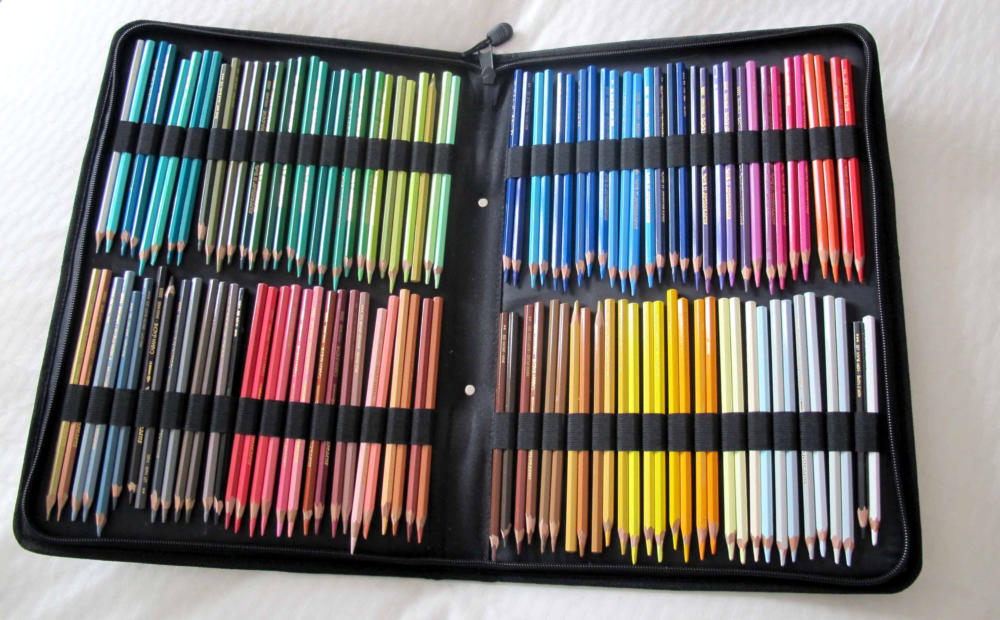
The most economical way to buy, if you are a specialist in one type of subject, is to get just the colours you need as single pencils. Store them in colour sets in pencil rolls, or separate cases which will hold 120 colours at a single opening.
I have a metal box of 120 Polychromos in three layers, where the bottom layer of reds, violets and yellows is hardly touched after five years. The top layers of greens, blues and greys are now in their third or fourth life.A full set of one brand can usually be supplemented by additional colours from another similar make.I
t is quite possible to use a full set of Caran d’Ache Pablo together with a selection of reds and yellows (and other colours) from the Faber-Castell Polychromos range (or vice versa, using greens and browns from Pablo with your Polychromos set).
You might like these
Staedtler pencils for the artist
Staedtler pencils include the Karat Aquarelle - branded as a student pencil should it be in your artist's coloured pencil toolbox?
Best Colored Pencils for Artists: Find The Right Brand For You
Discover the best colored pencils for artists that bring out vibrant, professional-quality results, with this simple test.
Cretacolor pencils - Karmina, Monolith and Marino Aquarelles
Cretacolor pencils from Austria are lightfast so well worth considering for your artwork


You might like these
Coloured Pencil Brands
A look at the coloured pencil brands available in the UK. How they differ and how lightfast they are.
Derwent pencils comparison and reviews for serious artists
Derwent pencils - a variety of coloured pencils suitable for beginners and experts, widely used by artists, illustrators and designers
Faber Castell Polychromos and Albrecht Durer pencil
Faber Castell Polychromos and Albrecht Durer pencil reviews. Are these the best coloured pencils for your art?
- Home
- Pencil brands
- Brand differences
Would you like our occasional newsletter?
Home | About Us | Contact Us | Privacy Policy
Copyright Peter Weatherill and Carol Leather - 2009-2024